Clean-in-Place (CIP) is standard in beverage production because manual cleaning is slow, labor-intensive, and prone to inconsistency. A well-designed CIP system cleans the internal wetted parts of a filling line without disassembly, protecting both product safety and brand reputation.
This article explains how CIP works, the six-step cleaning sequence, critical operating parameters, and how to validate the process. You will also find practical guidance for troubleshooting common CIP deviations.
What Is CIP (Clean-in-Place)?
Clean-in-Place (CIP) is an automated method of cleaning the internal surfaces of food and beverage equipment without taking it apart. It uses a controlled combination of water, chemicals, heat, and flow to remove product residues, deposits, and microorganisms from pipes, tanks, and filling nozzles.
Before CIP systems became common, operators had to manually open and scrub enclosed equipment. Manual cleaning took significant time and labor. CIP allows plants to perform frequent internal cleaning quickly, safely, and with highly repeatable results.
CIP vs. COP vs. SIP: What Is the Difference?
CIP cleans internal surfaces in place, COP requires removing parts for separate cleaning, and SIP uses steam or sanitizer to sterilize the product path.
| Process | Definition | Key Function |
|---|---|---|
| CIP | Cleans internal surfaces without disassembly. | Removes soils, residues, and deposits from pipes and nozzles. |
| COP | Requires partial dismantling of equipment. | Cleans removable components in a separate washing station. |
| SIP | Uses steam or chemical sanitizers in place. | Sterilizes the product path to eliminate microorganisms. |
How Does CIP Work in a Beverage Filling Line?
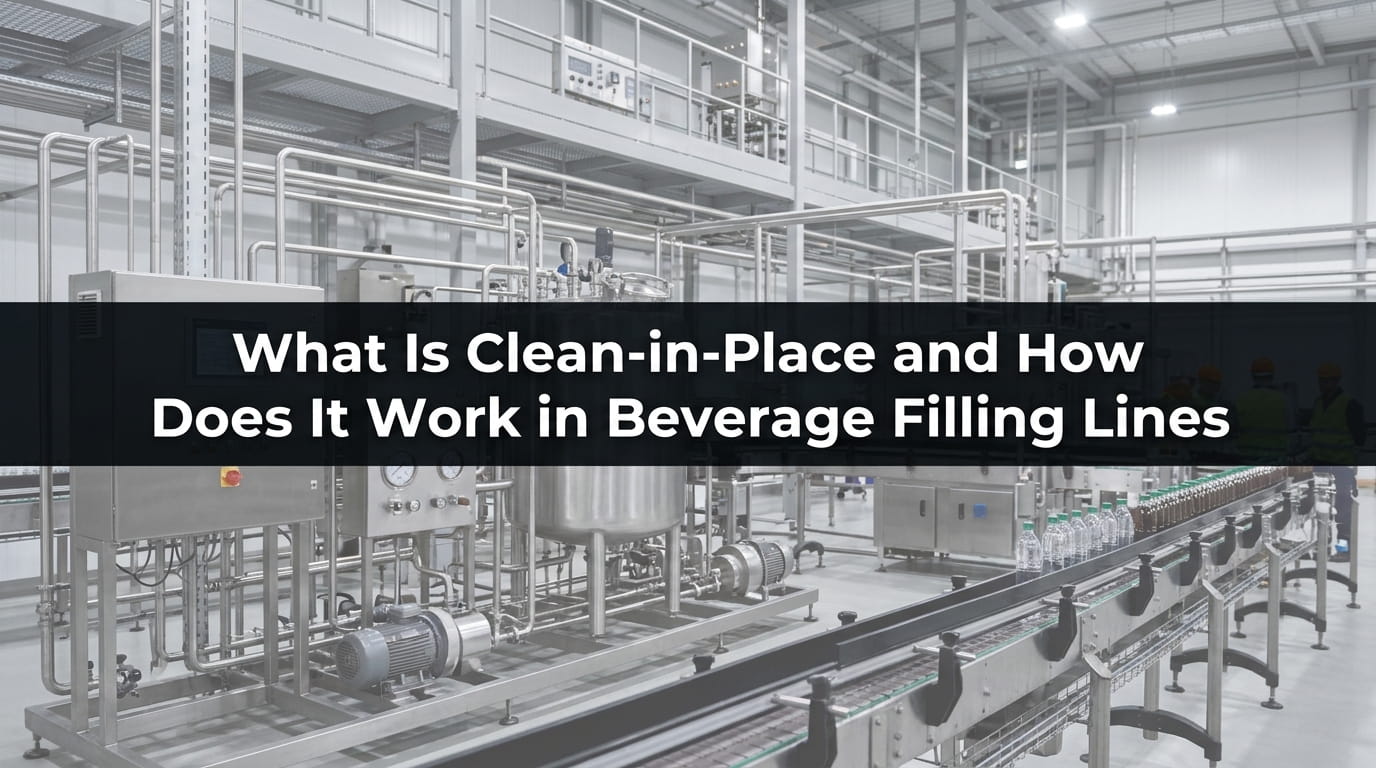
A CIP cycle circulates cleaning solutions through the exact same path your beverage takes, including tanks, pipes, valves, and filling nozzles. The system isolates the product line and cleans it in a closed loop.
Core Components of a CIP Skid
An automated CIP system typically includes:
- Storage tanks for acid, caustic solution, and hot water
- A plate heat exchanger to control temperature
- Supply and return pumps for circulating liquids
- Pneumatic valves to direct the flow
- pH and conductivity sensors to monitor chemistry
- A PLC (Programmable Logic Controller) and HMI (Human-Machine Interface) to automate and record the cycle
What Are the 6 Steps of a CIP Cleaning Sequence?
A standard beverage CIP cycle follows six sequential stages. The exact parameters must be validated for your specific product, soil load, and equipment design.
| Step | Medium | Concentration | Temperature | Time | Acceptance Criteria |
|---|---|---|---|---|---|
| 1. Pre-rinse | Drinking / hot water | — | Ambient to 70°C | 5 to 10 min | Clear discharge |
| 2. Caustic wash | NaOH (Caustic Soda) | 1% to 2.5% | 70 to 90°C | 20 to 30 min | Conductivity in range |
| 3. Intermediate rinse | Drinking water | — | Ambient to 70°C | 5 to 10 min | pH near inlet water |
| 4. Acid wash | HNO₃ (Nitric Acid) | 0.5% to 1.5% | 60 to 80°C | 15 to 20 min | Scheduled or as needed |
| 5. Sanitization | PAA / hot water / steam | 0.1% to 0.2% | ≥ 85°C | 10 to 15 min | Sanitizer verified |
| 6. Final rinse | Treated water | — | Ambient | Until clear | No detectable residue |
The sequence is designed to first flush away loose residues, then use alkaline chemistry to break down organic soils like sugars and fats, followed by an acid wash to dissolve mineral scale. The cycle concludes with a final rinse to ensure no chemical residue remains.
What Are the Critical CIP Parameters (TACT)?
CIP effectiveness depends on four interdependent factors known as TACT: Time, Action, Chemistry, and Temperature.
If you change one factor, you usually need to adjust the others. For example, if your filling machine has a maximum temperature limit of 70°C for its seals, you may need to extend the contact time or slightly increase the chemical concentration to achieve the same cleaning result.
- Time: How long the chemical touches the surface.
- Action: The mechanical energy. Turbulent flow or spray balls physically scrub the internal surfaces.
- Chemistry: The concentration of detergents and sanitizers.
- Temperature: The heat of the cleaning solution, which accelerates chemical reactions.
What Are the Types of CIP Systems?
Automated CIP systems are classified by solution handling into Single-Use (Type I) and Reuse (Type II) systems.
| System Type | Solution Handling | Advantage | Consideration |
|---|---|---|---|
| Single-Use (Type I) | Fresh solution for every cycle. | Lower cross-contamination risk. | Higher water and chemical consumption. |
| Reuse (Type II) | Recovers and reuses solutions. | Lower utility costs. | Requires strict monitoring of concentration and soil levels. |
How Often Should You Run CIP?
Cleaning frequency depends on the product type and the risk of microbial growth. The following ranges serve as general industry references.
| Application | Reference Frequency | Main Consideration |
|---|---|---|
| Dairy | Every 24 to 48 hours | High microbial risk |
| Beverages (CSD, Juice) | Every 1 to 3 days | Product type and sugar content |
| Sauces / Condiments | Every few days to 1 week | Heavy organic residues |
| Product changeover | Immediately | Incompatible products or allergens |
How to Validate CIP and Quality Control?
Verification proves the cleaning cycle worked. Common validation methods for beverage lines include:
- Visual inspection: Checking that the discharge water is completely clear.
- pH testing: Confirming the intermediate rinse reaches the inlet-water pH within ±0.5.
- Conductivity monitoring: Tracking that the caustic and acid concentrations are within the target range.
- ATP swab testing: Checking surface cleanliness, often using ≤150 RLU (Relative Light Units) as a reference limit.
- Riboflavin test: An annual verification using a UV light to confirm that spray balls cover all internal surfaces of tanks and vessels.
Records of these tests, along with CIP cycle data, should be kept for traceability and regulatory audits.
Common CIP Deviations and Troubleshooting
When CIP fails to meet acceptance criteria, the line cannot return to production until the issue is resolved.
| Issue | Possible Cause | Corrective Action |
|---|---|---|
| Temperature below target | Insufficient steam supply | Check steam supply and rerun the step; never manually shorten cleaning time |
| Conductivity not returning to baseline | Cleaning solution residue | Extend final rinsing in 5-minute increments; check the dosing pump |
| ATP result exceeds limit | Inadequate sanitation | Re-sanitize and repeat ATP testing; review CIP validation if failures persist |
| Filling valve not cleaned | Poor valve sealing | Install cleaning dummy cups and keep them in place until the CIP cycle finishes |
If CIP deviations are caused by worn filling valves or sealing issues, it may be time to review your machine’s overall maintenance plan. Read our complete guide on filling machine troubleshooting to diagnose and fix mechanical or electrical issues.
CIP-Ready Design for Beverage Filling Lines
CIP effectiveness starts with equipment design. If the machine has dead legs or rough welds, no amount of chemical circulation will clean it properly.
When selecting or upgrading a csd or juice filling line, look for these hygienic design features:
- 316L Stainless Steel: Used for all product contact parts.
- Crevice-Free Welds: Smooth interior surfaces that prevent soil buildup.
- Sloped Piping: Ensures complete drainage and prevents standing liquid.
- Dummy Cups: Special attachments that seal the filling valves during CIP, allowing cleaning fluid to circulate through the nozzles under pressure.
- Recipe-Driven HMI: Stores validated cleaning parameters for different products to ensure repeatability.
Retrofitting CIP to an existing line is often possible. The upgrade usually involves modifying the manifolds, installing dummy cups, and adding a CIP skid with pumps and heat exchangers.
Conclusion
CIP is not just a cleaning routine; it is a critical control point for product safety and operational efficiency. By understanding the six-step sequence, monitoring the TACT parameters, and validating the results, beverage manufacturers can prevent contamination and shorten changeover times.
At Modern Machinery, our beverage filling lines are designed with sanitary circuits and dummy cup connections to support fully automated CIP. If you are planning a new line or upgrading an existing one, our team can help you integrate a CIP solution that matches your production requirements.
Contact Modern Machinery today to discuss your CIP configuration and request a free layout and quote.