Choosing between a linear and a rotary filling machine affects your production speed, changeover flexibility, and long-term operating costs. The two designs work in fundamentally different ways, and each suits a different type of production. This article compares them on working principle, speed, cost, floor space, and application so you can match the right machine to your line.
Linear vs Rotary Filling Machine: Quick Answer
Linear filling machines use a straight-line layout and work in batches. They suit small to medium production up to about 2,000 to 3,000 BPH, offer fast changeover, and cost less. Rotary filling machines use a rotating carousel and work continuously. They suit high-volume production above 5,000 BPH, deliver higher accuracy, and use floor space more efficiently relative to output. The right choice depends on your output target, container format, available space, and budget.
How Each Machine Operates
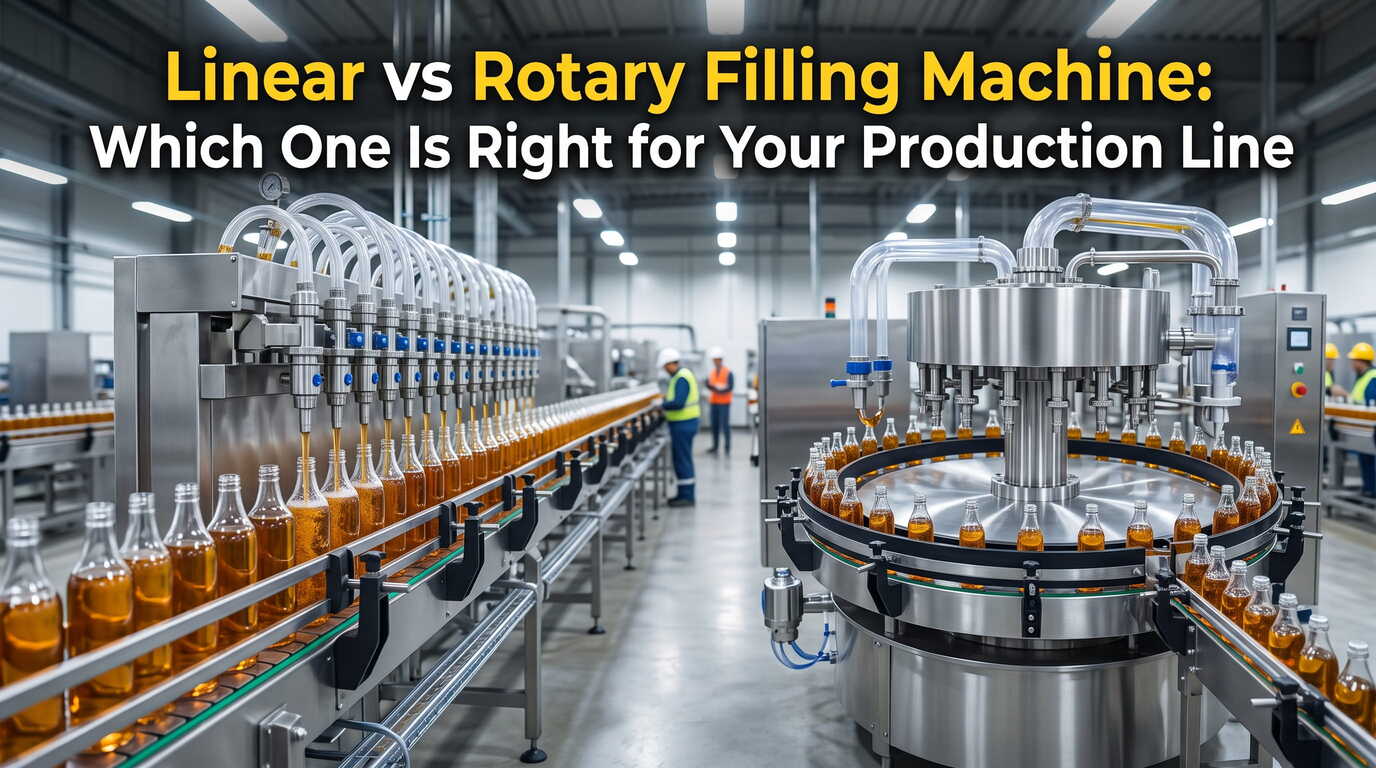
The key difference is motion. Linear machines move in batches, while rotary machines move without stopping. This difference shapes everything else, from speed to floor space.
Linear Filling Machine Working Principle
Containers enter the filling zone in a straight line. A row of nozzles descends and fills each container in the batch. After filling, the containers move forward, and the next batch takes their place. The cycle repeats. This design is simple and allows quick adjustments for different container sizes.
Rotary Filling Machine Working Principle
Containers enter a rotating carousel through an infeed star wheel. As the carousel turns, each container passes through rinsing, filling, and capping stations. The filling valves open and close in sync with the container’s position. Because motion is continuous, the machine can run at high speed without stopping for each batch.
Linear Filling Machine: Advantages and Limitations
Linear filling machines offer high flexibility for different container sizes and shapes. They are easy to scale up or modify without stopping production. The structure is simple, which makes operation and maintenance straightforward. They also take up less floor space and cost less to purchase than rotary machines.
However, the discontinuous filling process limits maximum speed. Linear machines typically suit small to medium production, up to around 2,000 to 3,000 BPH. They also require more manual operation during changeover.
Advantages of Linear Filling Machines
- High flexibility for different container sizes and shapes
- Easy to scale up or modify without stopping production
- Simple structure, easy to operate and maintain
- Smaller footprint than rotary machines
- Lower purchase cost and lower spare parts cost
Limitations of Linear Filling Machines
- Discontinuous filling process limits maximum speed
- Typically suited for small to medium production up to 2,000 to 3,000 BPH
- Requires more manual operation during changeover
Rotary Filling Machine: Advantages and Limitations
Rotary filling machines use continuous motion, which enables high-speed production. They deliver high filling accuracy and consistency. They also use floor space efficiently relative to output, and can integrate filling, sealing, and capping in one compact unit.
However, rotary machines have higher purchase and maintenance costs. They require more floor space for the rotary system. Changeover between container formats is more complex. They are best suited for consistent, high-volume production runs.
Advantages of Rotary Filling Machines
- Continuous motion enables high-speed production
- High filling accuracy and consistency
- Efficient use of floor space relative to output
- Can integrate filling, sealing, and capping in one compact unit
Limitations of Rotary Filling Machines
- Higher purchase cost and maintenance cost
- Requires more floor space for the rotary system
- Changeover between container formats is more complex
- Suited for consistent, high-volume production runs
Linear vs Rotary Filling Machine: Key Differences
| Factor | Linear Filling Machine | Rotary Filling Machine |
|---|---|---|
| Machine layout | Straight-line | Rotating carousel |
| Container movement | Along a straight path | Around a rotary system |
| Filling process | Discontinuous (stop-and-go) | Continuous |
| Typical speed | Up to 2,000 to 3,000 BPH | Thousands of containers per hour |
| Filling heads | 1 to 20 nozzles | 8 to 60 heads (typically 20 to 50) |
| Footprint | Small | Larger |
| Changeover | Fast and simple | More complex |
| Initial cost | Lower | Higher |
| Maintenance | Simple and low cost | Complex and higher cost |
| Best for | Small to medium production, multi-product lines | High-volume, single-product production |
Having compared the two designs side by side, let us look at how to match the machine to your production.
How to Choose Between Linear and Rotary Filling Machine
The choice between linear and rotary depends on your output target, container format, available space, and budget.
- Required output: Under 3,000 BPH, linear is usually sufficient. Above 5,000 BPH, rotary becomes more practical.
- Container format: If you run many different bottle sizes and shapes, linear offers faster changeover. If you run one or two standard formats at high volume, rotary is more efficient.
- Available floor space: Linear machines take up less space. Rotary machines require more room but deliver higher output per square meter.
- Budget: Linear machines cost less upfront. Rotary machines cost more but deliver higher throughput.
- Product type: Both designs handle liquids of various viscosities. Rotary machines are common for carbonated beverages and dairy. Linear machines are common for personal care, pharmaceuticals, and food products like sauces and oils.
For manufacturers running multiple products on one line, linear machines often provide better flexibility. For those running one product at high volume, rotary machines deliver better efficiency.
Linear vs Rotary Filling Machine Applications
Linear Filling Machine Applications
Linear filling machines are commonly used for:
- Personal care products (shampoos, lotions, creams)
- Pharmaceuticals (syrups, ointments)
- Food products (sauces, oils, thick liquids)
- Small to medium batch production with frequent product changes
Rotary Filling Machine Applications
Rotary filling machines are commonly used for:
- Carbonated soft drinks, juices, and water. See our carbonated soft drink filling lines for a complete solution example.
- Dairy products (milk, yogurt drinks)
- Pharmaceuticals (vials, syringes)
- Premium oils such as olive oil. For this application, see our rotary olive oil filling machine. Modern Machinery offers rotary olive oil filling machines for 250 ml to 2 L PET or glass bottles, with capacity from 3,000 to 12,000 BPH.
- High-volume production with consistent container formats
Conclusion
The choice between linear and rotary filling machines depends on your production volume, container formats, available space, and budget. Linear machines offer flexibility and lower cost for small to medium operations. Rotary machines deliver speed and efficiency for high-volume production.
If you need help selecting the right filling machine for your production line, contact Modern Machinery. Our team can evaluate your requirements and recommend the best configuration for your application.
FAQ
Which is faster, linear or rotary?
Rotary filling machines are faster. They use continuous motion and can fill thousands of containers per hour. Linear machines operate in batches and are typically limited to 2,000 to 3,000 BPH.
Which is more cost-effective for a small business?
Linear filling machines are more cost-effective for small to medium production. They cost less to purchase, take up less space, and are easier to maintain.
Can a linear filling machine handle high-viscosity products?
Yes. Linear machines with piston or servo-driven filling systems handle high-viscosity products like sauces, oils, and creams effectively. For edible oil and high-viscosity liquid applications, see our edible oil filling line.
When should I choose a rotary filling machine?
Choose rotary when you need high output above 5,000 BPH, run consistent container formats, and have sufficient floor space and budget.
Can rotary filling machines handle multiple bottle sizes?
Yes, but changeover takes longer than on a linear machine. Rotary machines work best when you run one or two standard formats at high volume.
What is the typical filling accuracy of linear and rotary machines?
Linear machines with servo-driven filling achieve accuracy of ±0.2% to ±0.5%. Rotary machines with flow-meter or servo-driven systems achieve similar accuracy, typically ±0.2% to ±0.5%. The exact accuracy depends on the filling system, product viscosity, and machine configuration.